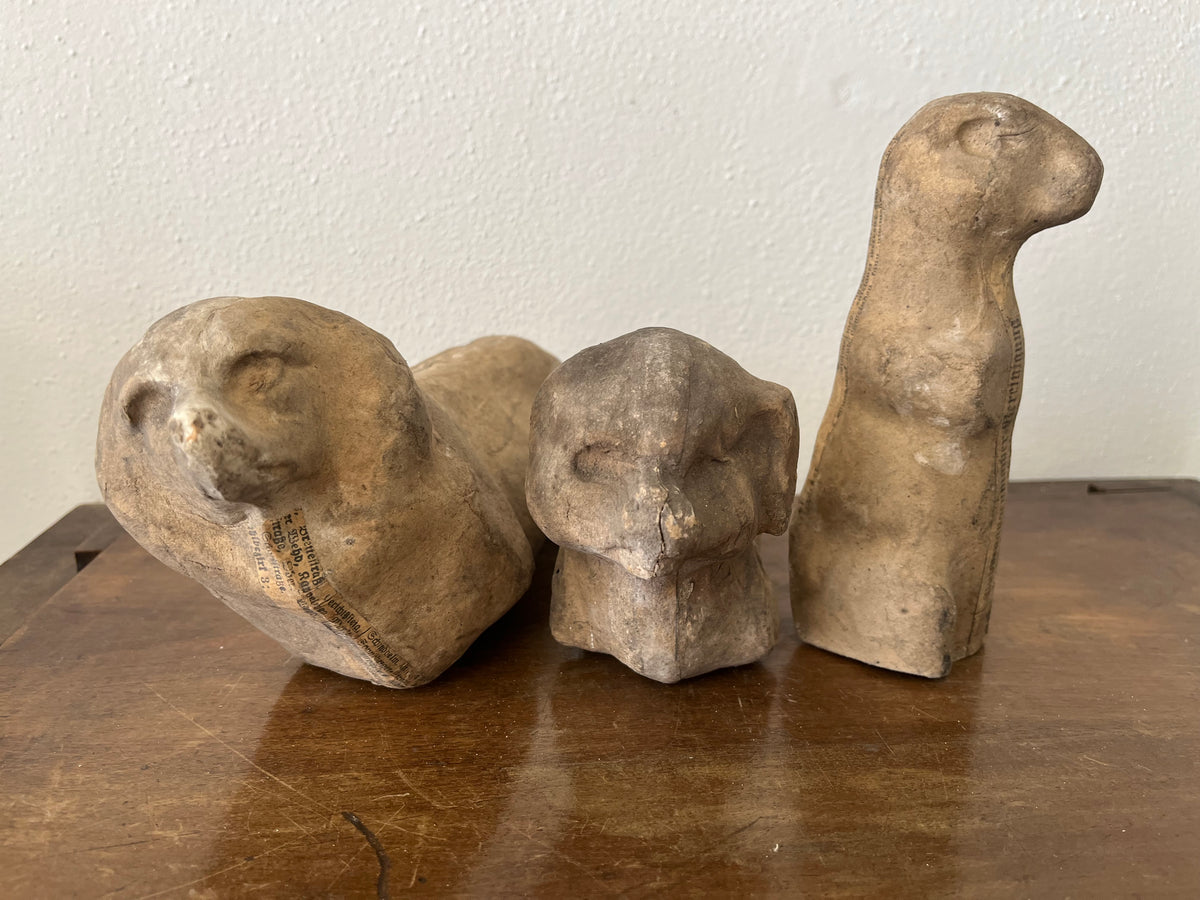
A splendid and extremely rare lot of three papier-mâché inner armatures/original factory models (Papiermaché-Formen), originating from the heart of the world’s toy manufacturing hub of the era: Sonneberg, Thuringia (Germany).
These objects were not toys intended for sale, but rather workshop tools used to shape or join the half-shells of the famous toys or candy containers typical of the Weimar Republic.
The figures are covered with strips of period German newspapers and documents printed in Gothic script, providing impeccable dating and traceability:
1. Small dog:
Features the clearly printed inscription on its back: "Sonneberg, den 18. November 1921".
2. Squirrel / Standing marmot:
Displays an official clipping from the doll manufacturers' association within the glassblowers' guild: "Puppenmacher-Vereinigung in der Glasbläser-Innung".
This figure clearly shows its hollow internal structure.
3. Large dachshund:
Covered with news clippings about political events mentioning the "Reichspräsident" (President of the Reich) and local commercial advertisements (including the famous Kathreiners Malzkaffee coffee substitute).
Dimensions:
• Large dog: 25 x 8 cm (height 12 cm)
• Small dog: 17 x 7 cm (height 12 cm)
• Squirrel / Marmot: 7 x 7 cm (height 15 cm)
Condition:
Excellent historical condition, structurally sound and solid.
They show the normal and fascinating patina of age, with perfectly legible text.
• Sonneberg: The world capital of toys
In the early decades of the twentieth century, the region around Sonneberg (Thuringia) was the beating heart of global toy production, exporting over 40% of the products on the market worldwide.
• A secret recipe: The "Sonneberg mass"
More durable than ordinary papier-mâché, Sonneberger Spielzeugmasse (toy mass) was a secret local formula combining pressed paper, hide glue, plaster, and flour to achieve incredibly precise sculptural details.
• A time capsule of the Weimar Republic
These pieces are true time capsules: the Fraktur script newspaper fragments document daily life in November 1921, even citing an official telegram from Germany's first President, Friedrich Ebert.
• The connection to the glassblowers of Lauscha
The inscriptions visible on the back directly link these models to the guild of doll eye manufacturers (Puppenaugenmacher).
The local artisans were indeed famous for creating the most realistic glass eyes of the era.
• Rare survivors of artisanal production
Having been created as inner armatures intended to be covered in fur or used as workshop molds, very few of these "naked" models have survived intact to this day, making them highly collectible historical pieces.
An extraordinarily rare lot for collectors of antique toys, industrial archaeology, and German history.