MemoriedOro
Rare Cast Iron Industrial Plaque - 1921 - 51x32 cm - Industrial Archaeology
Rare Cast Iron Industrial Plaque - 1921 - 51x32 cm - Industrial Archaeology
Couldn't load pickup availability
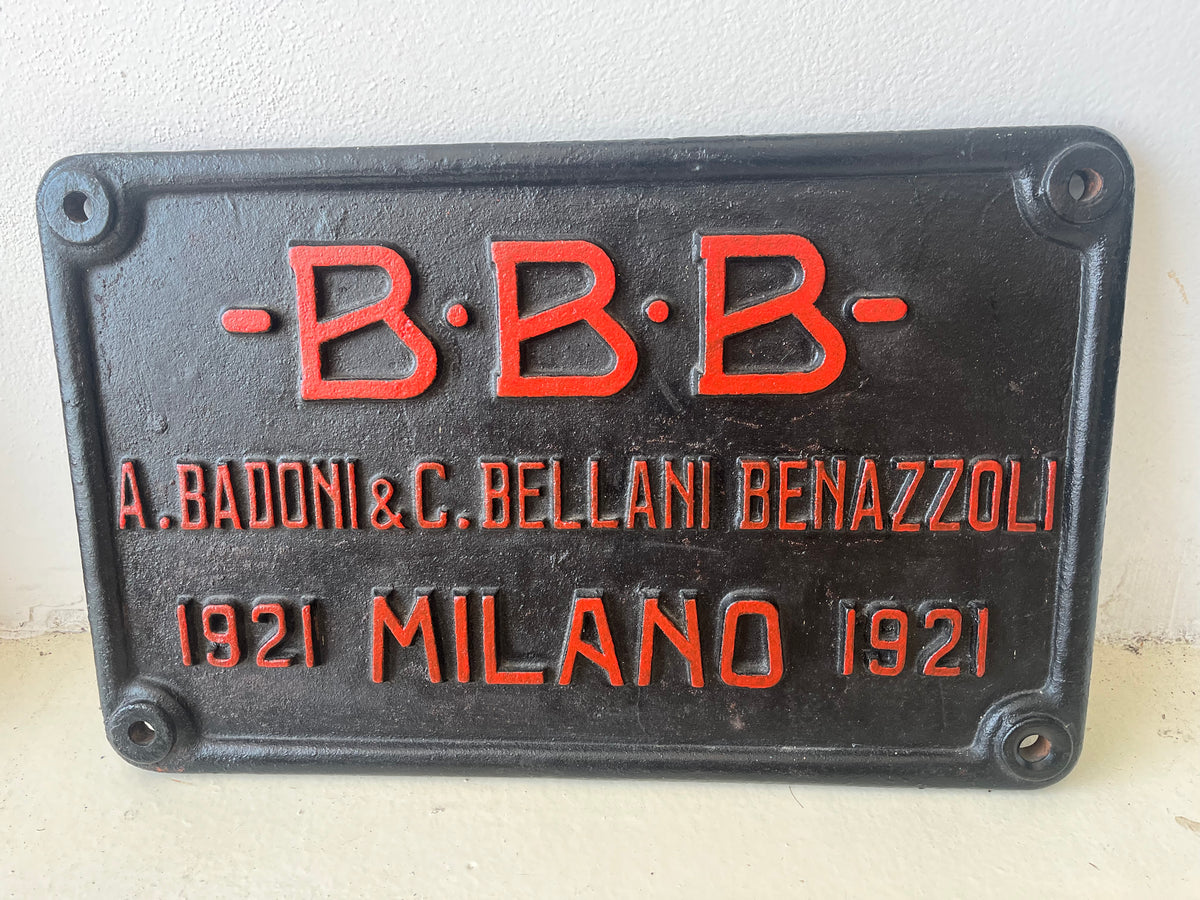
Heavy vintage industrial cast-iron plaque, dating back to 1921.
The artifact bears the name of the historic metallurgical company "B.B.B. - A. Badoni & C. Bellani Benazzoli - 1921 Milano 1921".
It is a piece of great historical interest for enthusiasts of industrial archaeology and vintage collecting: this specific company name (B.B.B.) based in Milan was active for only a few years (from 1915 to 1921), before the Badoni family regained full control of the company, transforming it into the famous "Antonio Badoni S.p.A." of Lecco.
Given its generous dimensions, this plate was originally bolted onto a large infrastructure or heavy machinery, such as port cranes, metal bridges, or cableway lifting systems.
Material: Sand-cast iron
Dimensions (approx.): 51 cm (length) x 32 cm (height) x 1.5 cm (maximum thickness)
Weight: Approximately 10-11 kg
The foundry model number "2044" is embossed in reverse on the back.
Equipped with 4 original reinforced corner holes for anchoring.
Condition:
The object is in excellent condition, structurally intact and free of cracks or fissures in the cast iron.
The back is clean and already fitted with modern protective felt pads on the support feet, making the plaque ready to be hung on a wall or displayed on furniture without the risk of scratching surfaces.
The "Società Anonima Antonio Badoni & C. Bellani e Benazzoli", known as B.B.B., was a historic metalworking company founded in Lecco in 1915 to boost wartime production, specializing in heavy structural steelwork and systems such as the "Telfer" monorail.
In 1922, after the Badoni family purchased all the shares, the company changed its name to "Antonio Badoni S.p.A.", becoming an iconic Italian brand in the construction of bridges, overhead cranes, and locomotives.
A cast-iron plaque marked "B.B.B. - A. Badoni & C. Bellani Benazzoli" is extremely rare because the firm used this name for only seven years, from 1915 to 1922.
Being linked to large industrial or military infrastructure and not mass-produced goods, the output of these plaques was very limited.
Furthermore, most artifacts from the era were destroyed due to subsequent demolitions and forced melting for metal recovery during World War II. Therefore, the very few surviving pieces today constitute true historical treasures for enthusiasts of industrial and railway archaeology.
Condividi